
By the end of this lesson, you should be able to…
- State Newton’s Third Law and identify action-reaction pairs
- Use the ABBA pattern to find the paired force for any given force
- Apply the three criteria that all action-reaction pairs must satisfy
- Distinguish between action-reaction pairs and balanced forces acting on the same object
D2 — Newton’s 3rd Law: Action and Reaction Pairs (4:40)
1. Newton’s Third Law
Every force has a “partner” force. These two paired forces are called an action-reaction pair. The key thing is that the two forces in the pair act on different objects — one on A, one on B.
Example: Water bottle on a table
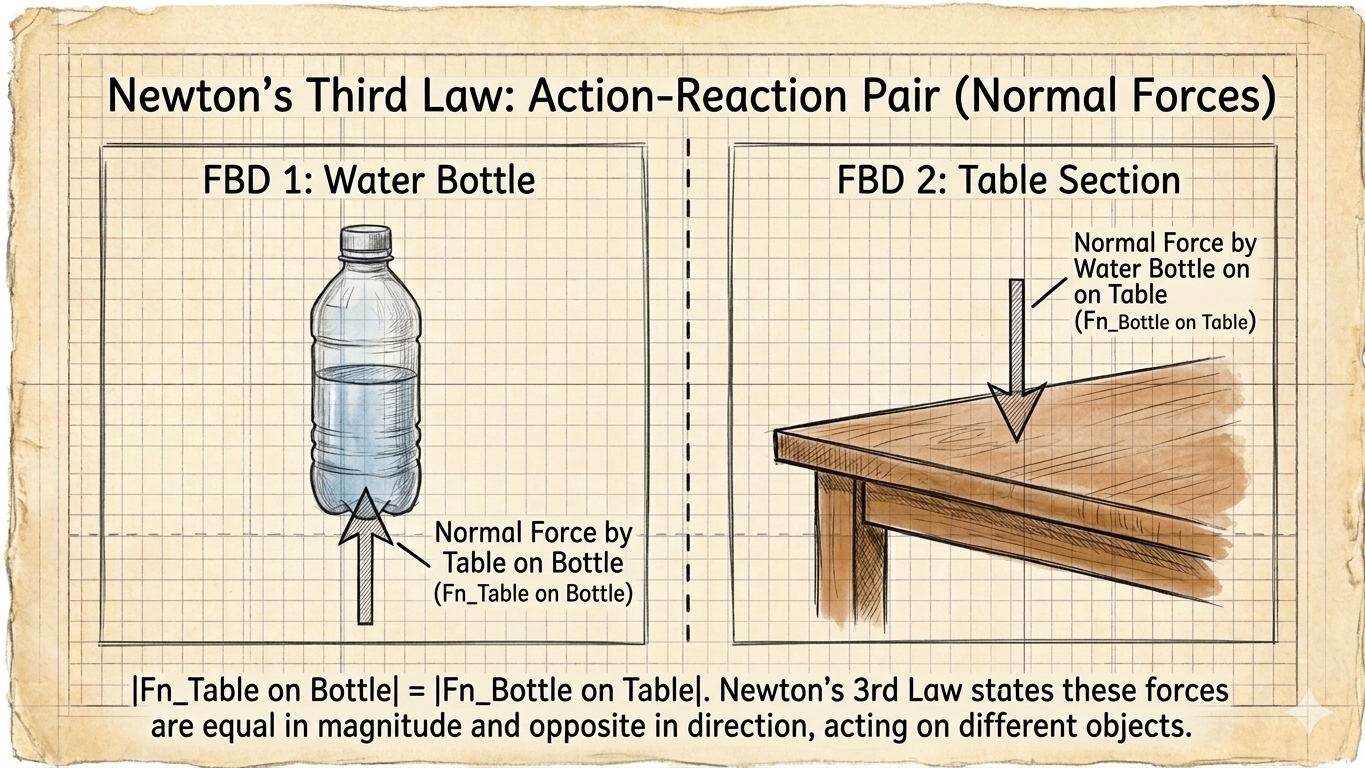
The bottle pushes down on the table (normal contact force).
By Newton’s 3rd Law, the table pushes up on the bottle (normal contact force).
These two forces are an action-reaction pair.
2. How to Identify Action-Reaction Pairs: The ABBA Pattern
To find the action-reaction partner of any given force, use the ABBA pattern. Write the force as a sentence in the form “force exerted on [Object A] by [Object B]”, then swap the two objects.
↓
Action-reaction pair: force exerted on table by bottle
The two objects simply swap places in the sentence. The type of force stays the same.
3. Three Criteria for Action-Reaction Pairs
An action-reaction pair of forces must satisfy all three of the following:
Checklist
- Equal in magnitude, opposite in direction. The forces are the same size and point in opposite directions.
- Acting on different objects. One force acts on A, the other on B. They will never appear on the same free body diagram.
- Same type of force. If one is a normal contact force, the other must also be a normal contact force. Friction pairs with friction; gravitational pairs with gravitational.
If you use the ABBA pattern correctly, criteria 1 and 2 are automatically satisfied. Always double-check criterion 3 explicitly.
4. Balanced Forces vs. Action-Reaction Pairs
This is one of the most common points of confusion in this topic:
Action-reaction pairs act on different objects and can never cancel each other.
Worked Examples
Given force: Normal contact force exerted on the wall by the person’s hand (directed into the wall).
ABBA swap: Normal contact force exerted on the person’s hand by the wall (directed away from the wall, back towards the person).
The wall exerts a real force on the person. This is why you feel resistance when you push a wall — the wall is literally pushing back on your hand.

Force 1: The rocket exerts a force on the gases (pushing them downward out of the engine).
ABBA swap: The gases exert a force on the rocket (pushing it upward).
It is this upward force from the gases on the rocket that propels the rocket forward. Note: the rocket and the gases are the two objects. There is no “wall” or external surface needed — this is why rockets work in the vacuum of space.

Try It Yourself
A horse pulls a cart forward. A student argues: “By Newton’s 3rd Law, the cart pulls the horse backward with an equal force. So the net force is zero and the horse-cart system can never accelerate.”
Identify the flaw in this argument.
The student has confused action-reaction pairs with balanced forces. The horse pulls the cart forward, and the cart pulls the horse backward — these are an action-reaction pair, acting on different objects. They cannot cancel each other because cancellation only happens when forces act on the same object.
To find the net force on the horse, we look at all forces on the horse alone (e.g. friction from the ground pushing the horse forward vs the cart pulling it backward). To find the net force on the cart, we look at all forces on the cart alone. Each object is analysed separately using its own free body diagram.
A student stands on a skateboard and pushes against a wall. Both the student and the skateboard move away from the wall. Using Newton’s 3rd Law, explain why the student moves away from the wall.
When the student pushes against the wall, the student exerts a force on the wall (directed towards the wall). By Newton’s 3rd Law, the wall exerts an equal and opposite force on the student (directed away from the wall). This reaction force from the wall on the student is an unbalanced force, which causes the student (and skateboard) to accelerate away from the wall.
Further Resources
- PhET: Forces and Motion Basics — explore how action-reaction forces work on a push/pull interactive
- The Physics Classroom: Newton’s 3rd Law — additional examples and practice questions