
🎯 By the end of this lesson, you will be able to:
- State the definition of a force and identify the two objects involved in any force
- Distinguish between contact forces and non-contact forces, with examples
- Draw a correct free body diagram for an object in a given situation
- Label each force arrow with its type and the object exerting it
1. What is a Force?
A force is a push or a pull exerted by one object on another object.

There are two key things to notice in this definition:
- Two objects are always involved. Every force has an object doing the pushing/pulling, and an object being pushed/pulled. Getting used to identifying both objects is essential for Newton’s Third Law later on.
- Force is a vector quantity. It has both a magnitude (how large) and a direction (which way). The SI unit is the Newton (N).
The water bottle on a table
Imagine a water bottle sitting still on a table. What forces are acting on the bottle?
- Weight — the gravitational force exerted by the Earth on the bottle, pulling it downward.
- Normal contact force — the force exerted by the table on the bottle, pushing it upward.

Notice how each force is described: we state the type, who is exerting it, and who is receiving it. This habit pays off enormously in exam questions.
2. Types of Forces
| Category | Force | Description |
|---|---|---|
| Contact forces (objects must be touching) |
Normal contact force | A surface pushes back on an object resting on it. Always acts perpendicular to the surface. |
| Friction | Opposes sliding motion. Acts along the surface, opposing the direction of motion or tendency to move. | |
| Tension | Pulling force in a string, rope, or cable. Acts along the string, away from the object. | |
| Non-contact forces (objects need not touch) |
Gravitational force (Weight) | Attraction between masses. On Earth, always acts downward towards the centre of the Earth. W = mg. |
where W is weight (N), m is mass (kg), and g = 10 N/kg on Earth’s surface.
 Contact forces require the objects to be touching; non-contact forces can act across a distance.
3. Free Body Diagrams
A free body diagram (FBD) is a sketch that shows all the forces acting on one object, with the object isolated from everything around it. It is the single most useful tool in Dynamics.
How to draw a free body diagram
- Isolate the object. Draw it as a simple box or dot and label it. Ignore everything else.
- Draw an arrow for each force acting on the object. The arrow starts at the object and points in the direction of the force.
- Label each arrow with: (a) the type of force, and (b) the object exerting it.
Example: “Weight — Earth on bottle”
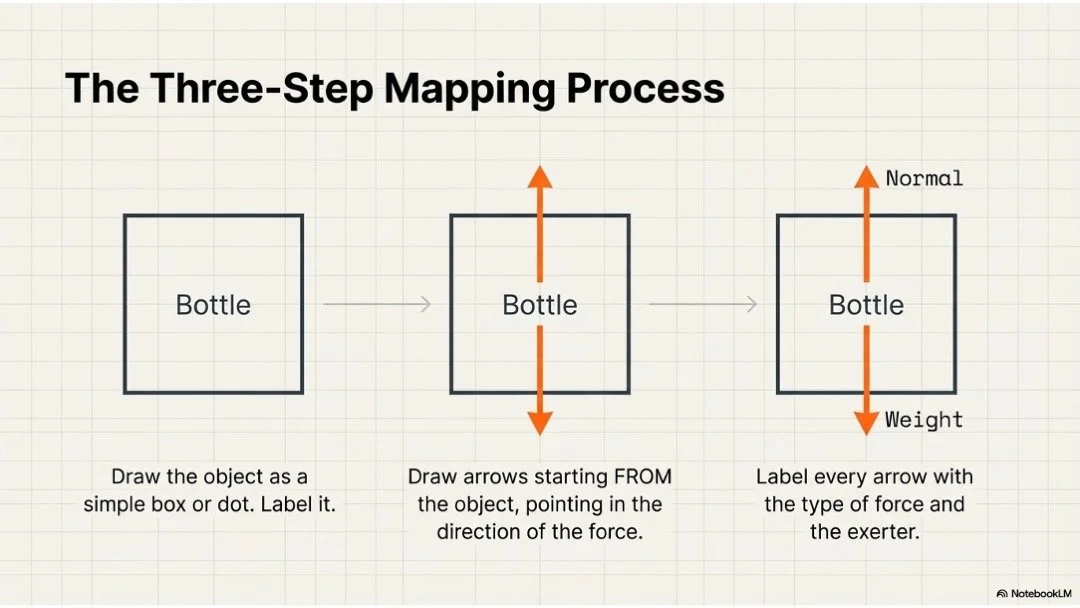 Both arrows are equal in length because the bottle is not accelerating (forces are balanced).
Important: what NOT to include
- Only draw forces acting on the object — not forces the object exerts on other things.
- Do not include velocity or acceleration as arrows — those are not forces.
- Weight always points straight down, even on inclined surfaces. Never draw it perpendicular to a slope.
Worked Examples
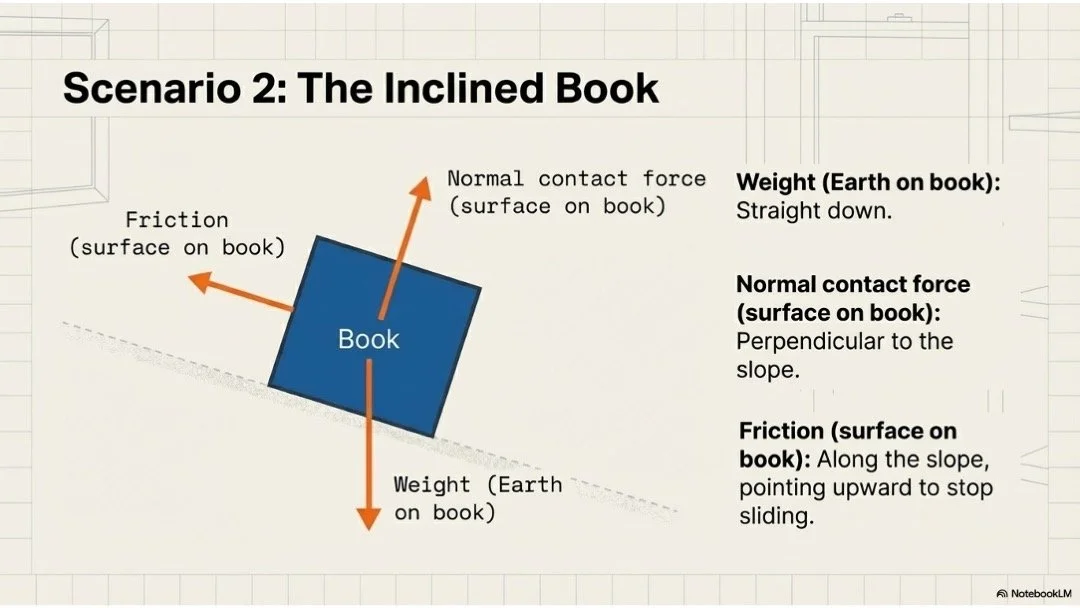
A textbook rests on a rough inclined surface. Draw and label the free body diagram for the textbook.
The textbook has three forces acting on it:
- Weight (Earth on book) — straight downward. This is the most common mistake: weight is always vertical, not perpendicular to the slope.
- Normal contact force (surface on book) — perpendicular to the inclined surface, pushing away from the slope.
- Friction (surface on book) — along the surface, pointing up the slope (opposing the book’s tendency to slide down).
A person pushes a crate to the right across a rough horizontal floor. The crate is moving. Identify all forces acting on the crate and draw the free body diagram.
The crate has four forces acting on it:
- Weight (Earth on crate) — downward
- Normal contact force (floor on crate) — upward
- Applied force (person on crate) — to the right
- Friction (floor on crate) — to the left (opposing rightward motion)
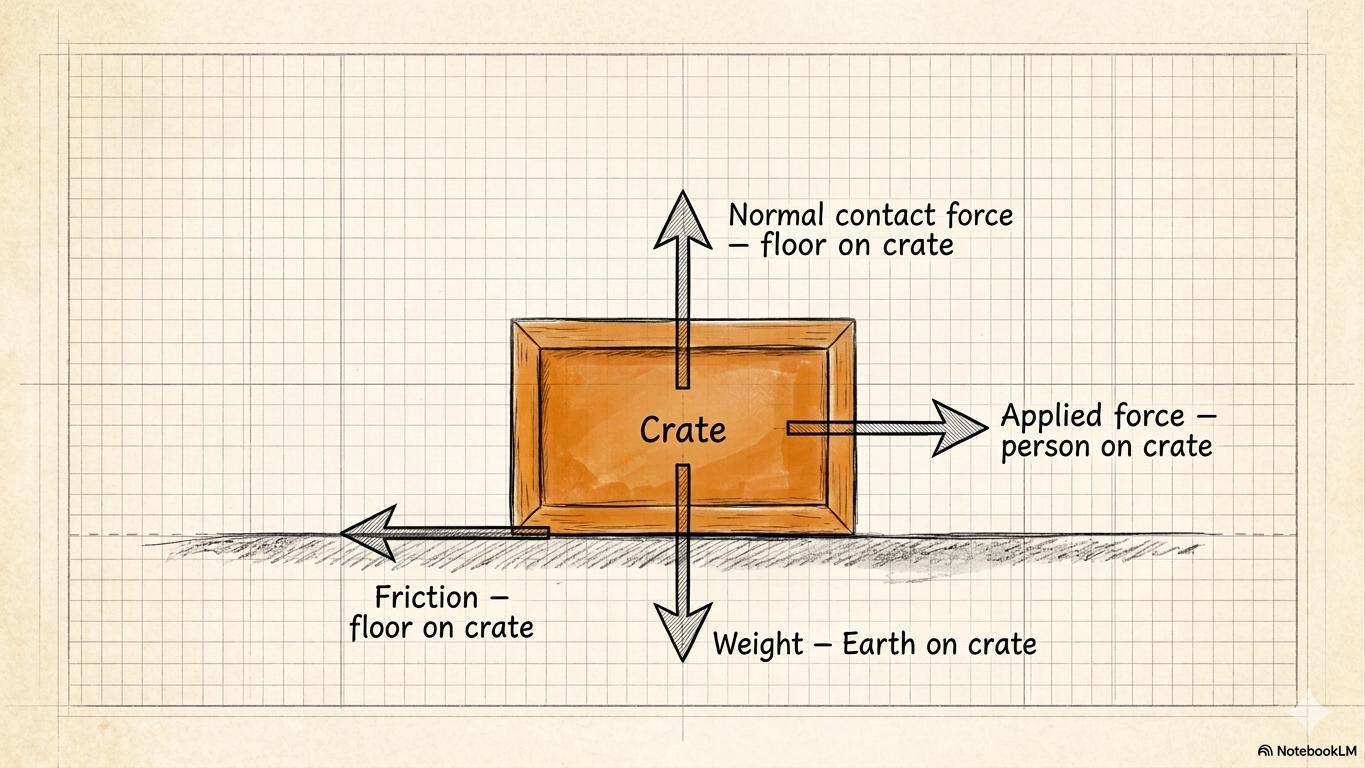
Note: The force the crate exerts on the person, or on the floor, is not included — those act on other objects, not on the crate.
✎ Try It Yourself
Question 1
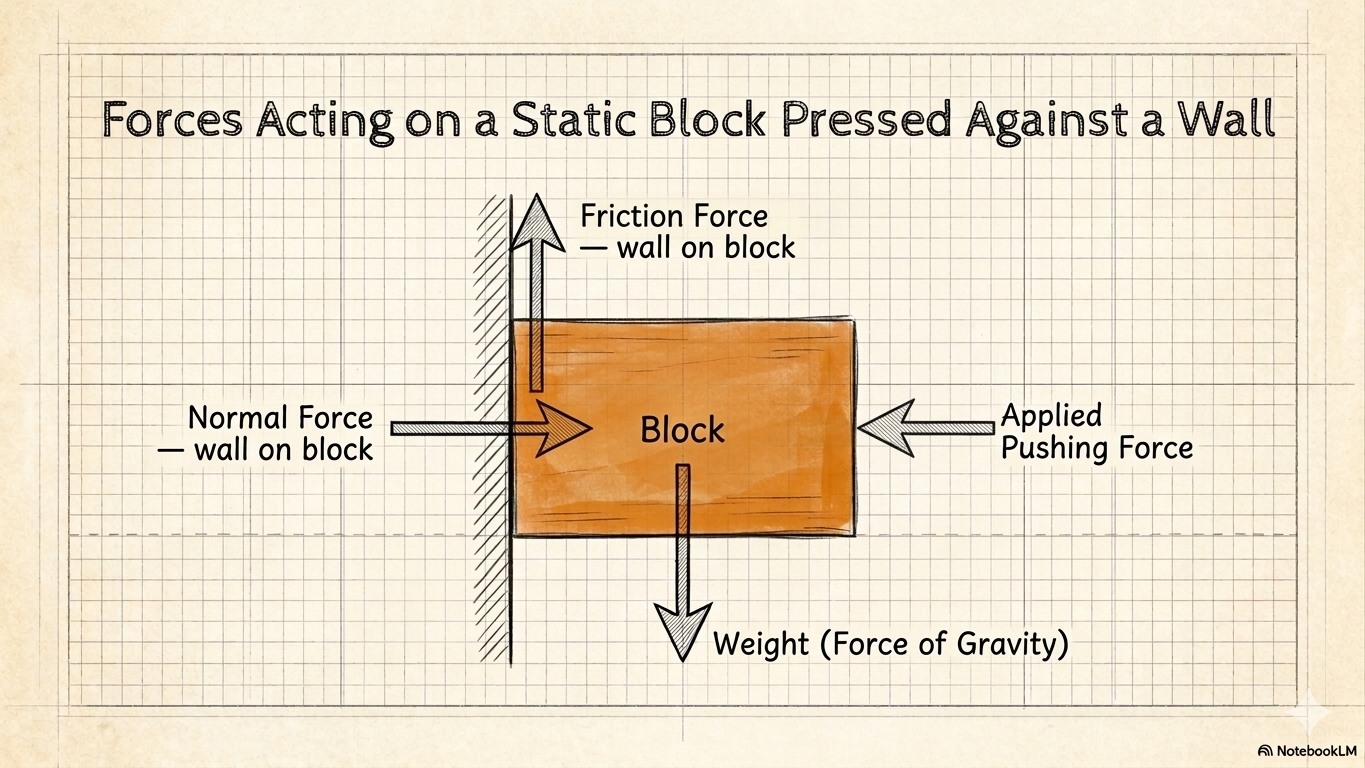
A wooden block is pressed against a rough vertical wall by a horizontal force, as shown. The block is not moving. List all the forces acting on the block.
There are four forces on the block:
- Weight (Earth on block) — downward
- Applied force (hand on block) — horizontal, towards the wall
- Normal contact force (wall on block) — horizontal, away from the wall
- Friction (wall on block) — upward (preventing the block from sliding down)
Since the block is stationary, forces are balanced: friction = weight; normal contact force = applied force.
Question 2
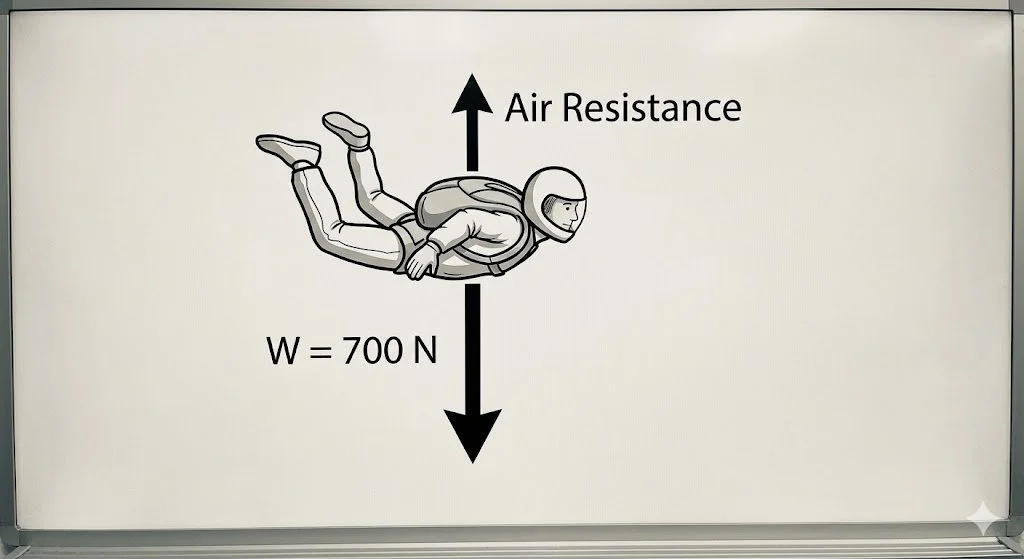
A skydiver of mass 70 kg is falling downward and speeding up. State the forces acting on her and determine which force is larger. Explain your reasoning.
Two forces act on the skydiver:
- Weight (Earth on skydiver) — downward. W = 70 × 10 = 700 N
- Air resistance (air on skydiver) — upward, opposing her downward motion
Weight is larger. Because she is speeding up (accelerating downward), there must be an overall unbalanced force acting downward. This means the downward force (weight) exceeds the upward force (air resistance).
This is a preview of Newton’s Second Law — an unbalanced force causes acceleration!
Further Resources
- PhET: Forces and Motion Basics — drag forces around and see how free body diagrams update in real time.
- The Physics Classroom: Drawing Free Body Diagrams